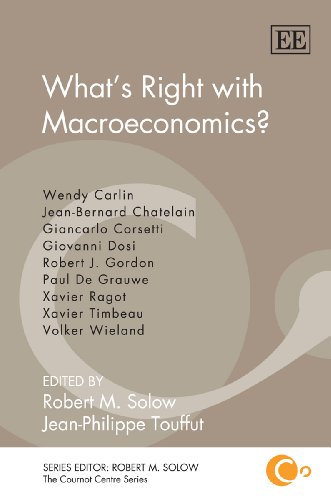
What´s Right with macroeconomics? / Edited by Robert M. Solow, Jean-Philippe Touffut ; [Wendy Carlin, Jean-Bernard Chatelain, Giancarlo Corsetti [y otros 6]]
Tipo de material: TextoIdioma: Inglés Series The Cournot Centre seriesDetalles de publicación: Cheltenham : Edward Elgar, ©2012Descripción: xvi, 240 páginas : ilustraciones y gráficas a blanco y negro ; 23 cmISBN:
 - 9781781007440
- 339 / S689w 23
| Tipo de ítem | Biblioteca actual | Colección | Signatura topográfica | Copia número | Estado | Código de barras | |
|---|---|---|---|---|---|---|---|
 Books
Books
|
Biblioteca Pública José María del Castillo y Rada | Non-fiction | 339 / S689w (Navegar estantería(Abre debajo)) | Ej.1 | Disponible | 430000339 |
Bibliografía al final de cada capítulo.
The fireman and the architect / Xavier Timbeau Model comparison and robustness a proposal for policy crisis analysis after the financial / Volker Wieland The 'hoc' of international macroeconomics after the crisis / Giancarlo Corsetti Try again, macroeconomists / Jean-Bernard Chatelain Economic policies with endogenous innovation and Keynesian demand management / Giovanni Dosi, Giorgio Fagiolo, Mauro Napoletano and Andrea Roventini Booms and busts, New Keynesian and behavioural explanations / Paul De Grauwe The economics of the laboratory mouse: where do we go from here? / Xavier Ragot Round table discussion where is macro going? / Wendy Carlin, Robert J Gordon and Robert M Solow
Global crises are very rare events. After the Great Depression and the Great Stagflation, new macroeconomic paradigms associated with a new policy regime emerged. This book addresses how some macroeconomic ideas have failed and examines which theories researchers should preserve and develop. It questions how the field of economics - still reeling from the global financial crisis initiated in the summer of 2007 - will respond.
The contributors, nine highly-renowned macroeconomists, highlight the virtues of eclectic macroeconomics over an authoritarian normative approach. They illustrate that macroeconomic reasoning can still be a useful tool for carrying out practical policy analysis. As for emerging research programmes, their wide-ranging chapters remind us that there are positive approaches to and reasons to believe in old-fashioned macroeconomics.
This challenging and thought-provoking book will prove a stimulating read for researchers, academics and students of economics, as well as for professional economists.
No hay comentarios en este titulo.